


Cootes to Escarpment Conservation and Land Management Strategy
Cootes to Escarpment Conservation and Land Management Strategy
Cootes to Escarpment
cootestoescarpmentpark.ca
$185,000 (over 3 years)
Grant Approved: April 2007
The Royal Botanical Gardens led a collaborative to undertake a conservation and land management planning process to protect 4,000 acres of natural Greenbelt lands within the municipalities of Hamilton and Burlington. The project is a partnership between the Royal Botanical Gardens, Hamilton and Halton Conservation Authorities, Hamilton Naturalists’ Club, Hamilton Harbour Remedial Action Plan, the Cities of Hamilton and Burlington, and the Region of Halton.
The area now referred to as the “Cootes to Escarpment Park System” is over 1500 hectares (3700 acres) of fragmented natural areas currently owned by various conservation groups, and adjacent to one of the Greenbelt’s most urbanized areas, the City of Hamilton. The large area of land and the many stakeholders involved provided a challenge to the Royal Botanical Gardens (RBG) to lead a collaborative process and create a plan to protect this valuable natural asset.
During the first year of the project, RBG hired a full-time project manager and held a public open house to generate interest in the planning process and a Stakeholder Advisory Committee. The open house was well attended with 200 people. There was high interest in the project and participation in the Advisory Committee, which was eventually established with 28 members. RBG also held a workshop for 35 representatives from partner and agency staff to discuss future management of the natural lands. During this time the grantee also established a website and completed the “Phase 1 Background Report” for the land management strategy. A comprehensive report, the Conservation and Land Management Strategy, was the result of the second phase of the project, and is accompanied by the Vision document which was released to the public and media. The grantee reported that the “single most positive element of the project [was] the public’s almost unanimous support for the project and their extensive participation and interest in the process.” Not only was attendance high at open houses and the Advisory Committee, but letters to the editor, editorials and independently-authored newspaper articles also demonstrated strong, vocal public support for protection and enhancing the area. RBG reports that the completion of the Strategy means that they, and the other two charitable partners in the process, are now in a better position to seek funding for specific activities to implement the Vision.
In 2007, the population of the Hamilton area was expected to increase by 37% over 20 years, placing increasing pressure on natural lands so close to the urban boundary, both from development and increased recreational use. These pressures cause habitat fragmentation for flora and fauna, as well as disturbing sensitive habitats where they are intact. The planning process resulted in interest from stakeholders in securing lands and starting stewardship projects to restore degraded areas. Also important, there is now a collective interest in ensuring appropriate, sustainable recreational use in the area to preserve these natural assets. The long-term implementation of this project was important for protecting this key natural heritage area of the Greenbelt, for the benefit of not only Hamilton and Burlington residents, but those in and around the Greenbelt. The partners all brought valuable resources to the implementation phase. Among other implementation activities, a land securement strategy was planned to expand the protection to neighbouring properties and private land owners. In partnership with RBG, the Foundation helped to host a launch event for the Vision in February 2010, a part of the Greenbelt’s 5th Anniversary celebrations, at RBG’s Nature Centre. A short, informal ceremony with dignitaries and remarks was followed by outdoor activities for adults and kids led by partners.

Best Practices Guide to Natural Heritage Systems Planning

 Best Practices Guide to Natural Heritage Systems Planning – 6 MB
Natural heritage systems planning is about maintaining, restoring and enhancing ecologically sustainable and resilient landscapes. It is a strategic approach to addressing biodiversity loss, land use change and the uncertainties of climate change so that we always have clean air, clean water and a rich diversity of plant and animal life to sustain present and future generations. Natural heritage systems planning seeks to engage communities and educate citizens about the many benefits that nature provides and about nature's fundamental place in supporting social and economic health.
July 2014 Newsletter
July 2014 Newsletter
July in the world's largest greenbelt -- a month in review.
This month's newsletter features:
- Making Natural Connections Across Ontario's Greenbelt
- The Bruce Peninsula Conservation and Stewardship Plan launches
- Greenbelt Harvest Picnic: Pick It!
- And more... !
Come and enjoy this year’s Greenbelt Harvest Picnic

The Greenbelt booth at the Picnic provides insight and information about the Greenbelt and how to get involved.
Photo Credit: Melanie Schade, 2013.
Now in its fourth year, the Greenbelt Harvest Picnic has been called one of the 10 best outdoor music shows by the Globe and Mail.
But it's more than a music show. It's a celebration of food and farming. It's an opportunity to be active in a gorgeous conservation area. And it’s a chance to spend a day with family and friends.
Biodiversity Tour launches Bruce Peninsula's Conservation and Stewardship Plan
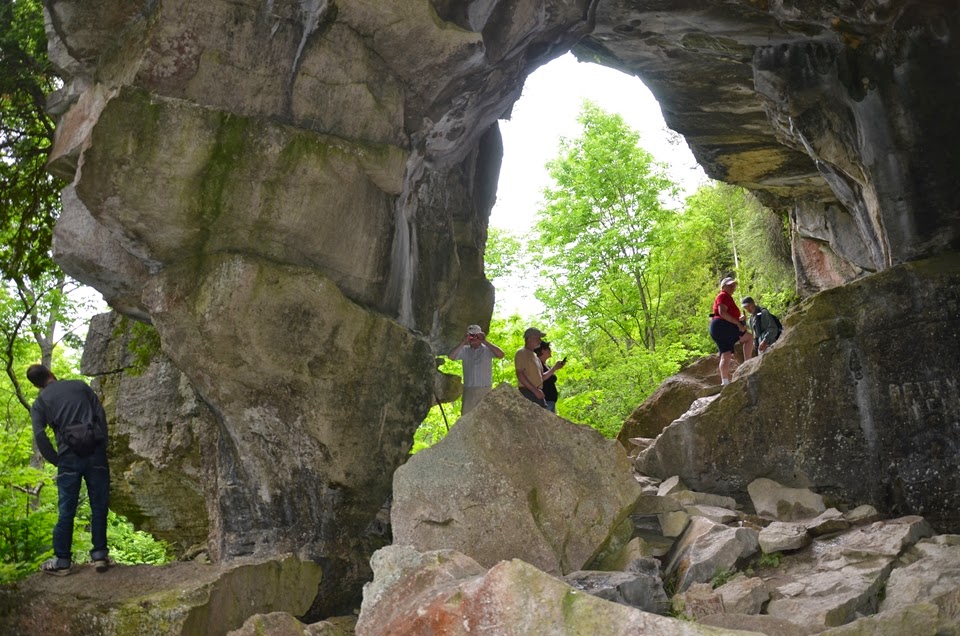 Participants on the Biodiversity Tour explored the rugged rocks and caverns of Greig's Caves south of Lion's Head.
We carefully climbed the rugged rocks at Greig's Caves while glancing up at the cavernous dolostone looming overhead. Our guides Sean Liipere, Program Manager for the Bruce Peninsula Biosphere Association and Jenna McGuire, naturalist at the Bruce Peninsula National Park, excitedly pointed upwards to the old white cedar growing out of the cliff. Over a century ago fires had decimated so many of the Peninsula's ancient forests it was possible to see the waters of Georgian Bay then turn and look at Lake Huron.
MAKING NATURAL CONNECTIONS ACROSS ONTARIO’S GREENBELT
FOR IMMEDIATE RELEASE
July 30, 2014
MAKING NATURAL CONNECTIONS ACROSS ONTARIO'S GREENBELT
Innovative Projects Support Farmers, Environment, Economy, and More
From guided tours and workshops in Northumberland County to engaging landowners in Hamilton-Burlington’s Cootes to Escarpment EcoPark, the latest projects from the Friends of the Greenbelt Foundation continue to support the viability and protection of Ontario's vast and world-leading Greenbelt.
The Next Generation of Farmers’ Markets

Agriculture in Norfolk County, Ontario.
Many people think of farmers as the average white male in his 50s, inheriting the farm from generations of family tradition on hundreds of acres of land. While this may be the case for most farmers and is indeed becoming a demographic challenge, a new trend of first generation farmers is growing. For some, entering the business is popular, especially when involved with farmers’ markets.
Celebrating Canada's Parks Day

Having grown up with a cottage in Kawartha Lakes, my family and I have passed Balsam Lake Provincial Park countless times. From observing and interacting with wildlife, swimming in the freshwater lakes, and pit stops for the occasional fresh strawberries and corn on the cob, my life has been filled with the advantages that our parks provide; advantages that I'm reminded of each day.
Farmers' Markets and the Community

Farmers' markets showcase fresh fruit and vegetables along with beautiful displays.
Farmers’ markets not only provide local food, they also bring communities together. As both a foodie attraction and social function, markets attract neighbours, musicians, farmers, and entertainers, encouraging and growing the most fresh and delicious food our province has to offer.
June 2014 Newsletter
June 2014 Newsletter
A warm, summer's month in review.
This month's newsletter features:
- Municipal Leaders for the Greenbelt: "Grow the Greenbelt, Make a Foodbelt!"
- John Holland donates a gem to the Cootes to Escarpment EcoPark System
- What are our Local Food Challengers up to?
- And more... !