


Water Use in Ontario's Greenbelt: A Foundation for Understanding the Costs and Benefits of Adaption Measures During Water Shortages
Southern Ontario’s water resources face combined pressure from human population growth and a changing climate that may bring drought events. Agricultural adaptation measures can play a role in water budgets. This research looked at the role of population growth and drought events on the water usage in and around Ontario’s Greenbelt. Additionally, agricultural adaptation measures were modeled to explore impacts and the cost benefit of these measures.

Integration of Natural Assets into Municipal Asset Management Plans
The Greenbelt Foundation, in partnership with Watson & Associates Economists Ltd., undertook a comprehensive project to assess how municipalities within Ontario's Greenbelt are integrating natural assets—such as wetlands, forests, and rivers—into their asset management plans. This work, published in 2024, evaluates municipal progress in complying with Ontario Regulation 588/17, which requires natural assets to be included in asset management plans by 2024. By advancing this integration, the project aims to help municipalities harness the benefits of natural systems for essential services, such as water management, climate resilience, and cost-effective infrastructure solutions.
Regional Soil Health Report
Regional Soil Health Report
The Greenbelt Foundation, in partnership with the Soil Health Institute, has released a Regional Soil Health Report based on two years of on-farm data from 264 fields across the Greater Golden Horseshoe. This report presents clear soil health benchmarks across soil textures, helping farmers understand how healthy their soil is today, what’s possible, and the practical steps to improve them.
This report provides regional soil health data, providing farmers with the ability to make data-driven soil management decisions that can improve soil health on their farms.
Farmers who adopted soil health practices had healthier soils across all measured indicators, including a 12% increase in water holding capacity, 28% increase in soil respiration, 39% increase in mineralizable nitrogen, and a 16% increase in aggregate stability.
Stories From The Greenbelt: Preventing the Spread of Invasive Species in Ontario’s Greenbelt
Written by Madison Sturba, Invasive Species Centre
The Greenbelt is incredibly diverse, with countless organisms living in its protected forests, wetlands, rivers, fields, and grasslands. These ecosystems support over 70 species at risk, including the wood turtle, butternut tree, and red-headed woodpecker. The survival of these species (and many others) really depends on the continued protection and health of these natural spaces.
Invasive species are one of the biggest threats to biodiversity in the Greenbelt. Invasive species are non-native organisms that have been introduced to an ecosystem outside of their native range and cause significant ecological, economic, and social harm in their new environment. Invasive plants, animals, insects, fish, and fungi can dominate the landscape and cause drastic changes as they outcompete native species for resources.
Stories From The Greenbelt: Great Waterfront Trail Adventure 2025 Recap: 8 Days, 3 Great Lakes, So Many Memories.
Great Waterfront Trail Adventure 2025 Recap: 8 Days, 3 Great Lakes, So Many Memories.
Written by Martin Lortz.
Every August, cyclists from across Ontario (and beyond) gather to enjoy one of the province’s most scenic cycling tours: the Great Waterfront Trail Adventure (GWTA). The 2025 edition was no exception, featuring eight days of lakeside riding, cultural stops, and unforgettable sunsets along Ontario’s Great Lakes.
Stories From the Greenbelt: A Memorable First Time at AMO: Connection, Support, and a Shared Love for the Greenbelt
A Memorable First Time at AMO: Connection, Support, and a Shared Love for the Greenbelt
Written by Serena Luk, Manager Content and Media Relations, Greenbelt Foundation
Last week, I had the opportunity to attend my very first Association of Municipalities of Ontario (AMO) Conference in Ottawa, and I have to say, it was an experience I won’t forget any time soon.
As someone who works day-to-day to support and protect Ontario’s Greenbelt, I’ve always known the importance of our work. But being at AMO surrounded by passionate, community-minded people from every corner of the province made it hit home in a whole new way.
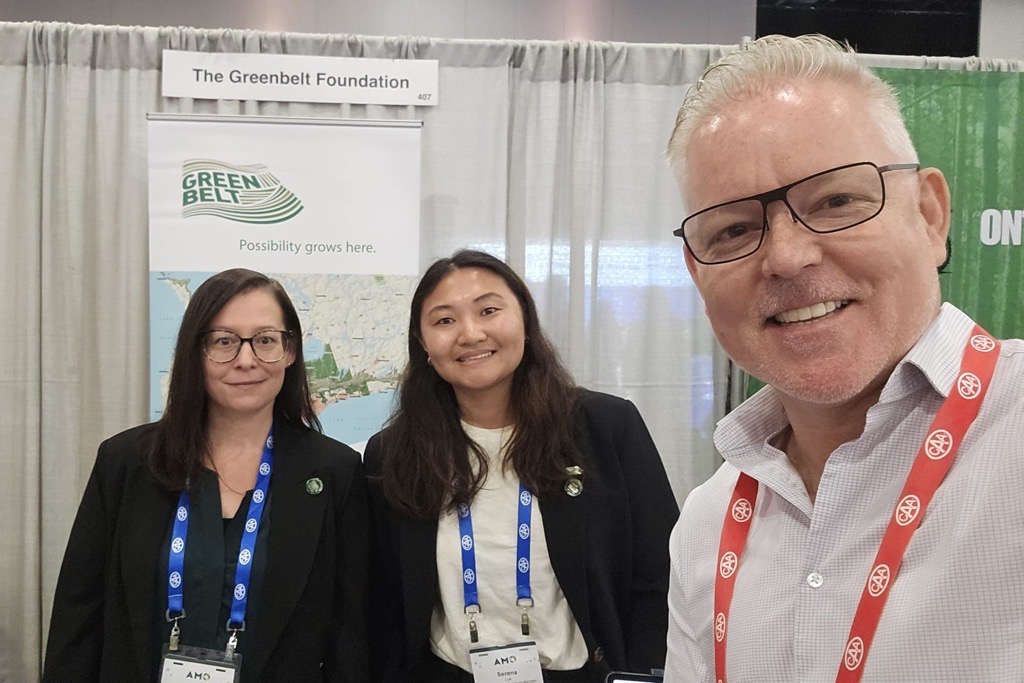
Pictured (left to right): Danielle Letang Senior Policy Advisor, Serena Luk Manager Content and Media Relations, and Edward McDonnell CEO
Natural Asset Management: Advancing Policy Innovation and Municipal Leadership
Many municipalities are turning to nature-based solutions to help address significant challenges of providing services to a growing population, managing aging infrastructure and strained budgets, and protecting communities by mitigating risks associated with climate change.
Natural asset management (NAM) is the practice of identifying, valuing and managing natural assets to provide critical municipal services. Maintaining and enhancing these services makes economic sense as nature-based infrastructure can be significantly cheaper than traditional grey infrastructure and provide the same or enhanced levels of service.
This report was created by the Greenbelt Foundation in collaboration with Asset Management Ontario (AMONTario) as a guide for municipal councillors and senior staff to advance natural asset management within their jurisdictions, no matter their level of experience with NAM.
The report contains 24 actions councillors can take along with rationales for each action and Ontario examples demonstrating where they have been successfully implemented.
Stories From The Greenbelt: Building Homes, Supporting Farms and Tackling Rural Housing Needs in the Greenbelt
Stories From The Greenbelt: Building Homes, Supporting Farms and Tackling Rural Housing Needs in the Greenbelt
Written by Wayne Caldwell, Report Author
In communities across Ontario’s Greenbelt, housing pressures are being felt not only in towns and villages but also on farms and in the countryside. Our recent report, Housing Needs and Actions for the Agricultural Sector in Rural Greenbelt Communities, shines a spotlight on the unique housing challenges facing rural and agricultural areas — and offers clear, practical solutions.
Stories From The Greenbelt: Finding Connection on the Oak Ridges Moraine Trail: A Hike Leader’s Reflection
Stories From The Greenbelt: Finding Connection on the Oak Ridges Moraine Trail
Written by Karen Graham, President, Oak Ridges Trail Association
A Hike Leader’s Reflection
As one of 34 active volunteer hike leaders with the Oak Ridges Trail Association, I’ve had the privilege of exploring and sharing some of Ontario’s most beautiful landscapes with fellow hikers. Each hike is a new opportunity - to connect with nature, to meet new people, and to experience the ever-changing beauty of the Oak Ridges Moraine.
What makes this trail so special is its diversity. From the towering hemlocks and white pines of the Ganaraska Forest to the rolling hills of Uxbridge and the rich biodiversity of the Northumberland Forest, no two hikes are ever the same. The trail winds through forests, wetlands, and meadows, offering something for every kind of hiker, whether you're looking to get your heart rate up or simply enjoy a peaceful stroll through the woods.